7TH PLACE : LAYAG
7TH PLACE : LAYAG
Celso S. Barredo III , Leoncio Delfin B. Duran III, and Jan Gil Laurenze R. Hernandez
National University – Mall of Asia
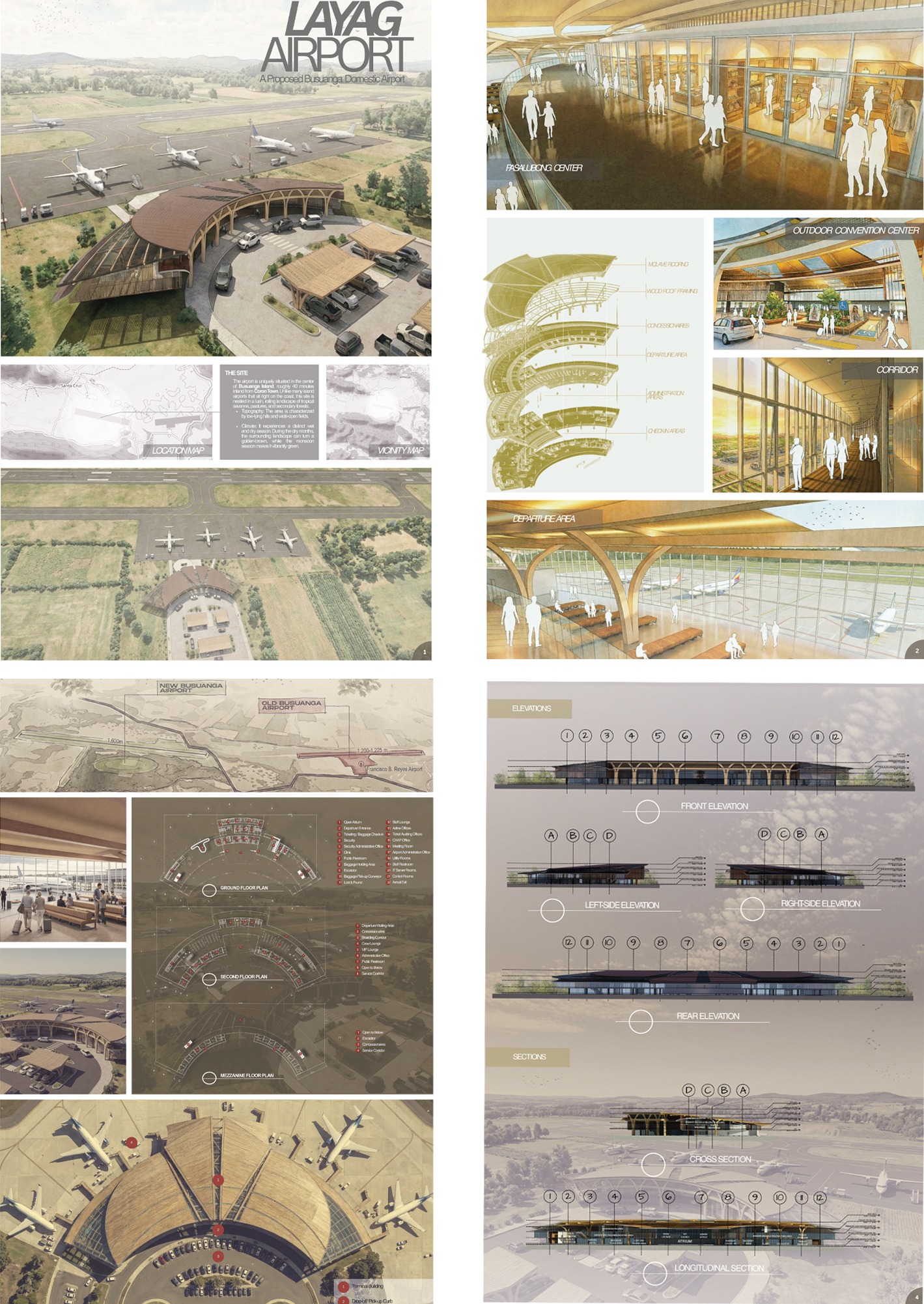
The reconstruction and redesign of the domestic airport in Busuanga, Palawan—Layagan Airport—was conceived as a response to the growing demands of tourism while remaining deeply rooted in the identity of Coron and the wider Calamianes Islands. As a gateway to a culturally diverse and ecologically sensitive region, the airport is envisioned not merely as an infrastructure project, but as an architectural narrative that reflects history, culture, and place.
The concept of juxtaposition is central to the design. Coron’s identity is shaped by layers of history—from its early seafaring inhabitants, the Tagbanua and Calamianes, to later settlers from Cuyo, Visayas, and Spanish-era immigrants. Even the name “Coron” speaks of this layered past, possibly derived from the Cuyonon word for “pot” or the Tagbanua word meaning “enclosed,” referencing its mountainous landscape. These contrasts between enclosure and openness, tradition and modernity, are translated into the airport’s architectural language. The new structure balances contemporary airport requirements with vernacular forms inspired by local dwellings and craft traditions.
Embedding culture into the design was a primary objective. Local manufacturing practices—such as the production of sawali, banig mats, baskets, and other handicrafts made from bamboo, rattan, and pandan—served as key references. These materials informed textures, screens, and façade treatments, allowing the building to resonate with the community’s craftsmanship while supporting local identity. In this way, the airport becomes a cultural threshold, introducing visitors to Coron’s heritage upon arrival.
Vernacular architecture principles were further integrated through the use of natural ventilation and passive cooling strategies. A double façade system was employed to reduce heat gain while allowing airflow, echoing traditional building methods adapted to the tropical climate. This system enhances thermal comfort, minimizes energy consumption, and responds to the island’s environmental conditions.
As Coron continues its shift from mining and manufacturing toward ecotourism, the redesigned airport addresses the inadequacy of the existing structure in handling increased passenger flow. At the same time, it acknowledges the paradox of tourism—serving as both an economic opportunity and a potential threat. Through thoughtful design, the airport aspires to protect the island’s character, ensuring that growth does not come at the cost of cultural and environmental integrity.