2ND PLACE: A Scene of Pangasinan
2ND PLACE: A Scene of Pangasinan
Ma. Katrina C. Patricio,Gregory Rivera, and Rehd Voltaire R. Taeza
National University – Manila
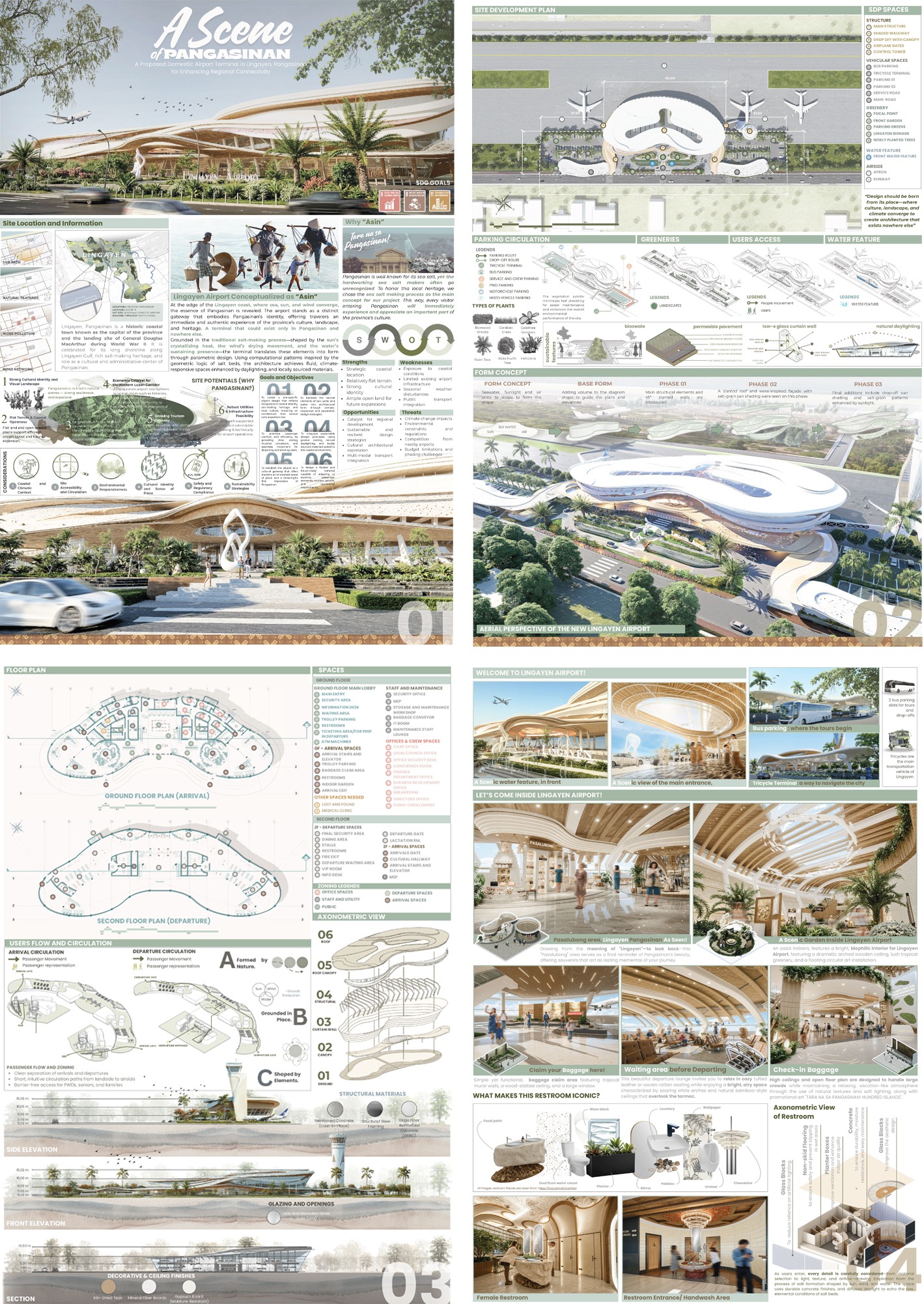
A Proposed Domestic Airport Terminal in Lingayen, Pangasinan for Enhancing Regional Connectivity
At the edge of the Lingayen coast, where sea, sun, and wind converge, the essence of Pangasinan is revealed. This proposed domestic airport is envisioned as more than a transportation facility; it is a distinct gateway that embodies the province’s identity, offering travelers an immediate and authentic experience of Pangasinan’s culture, landscape, and heritage. Titled “A SCENE of Pangasinan,” the concept draws from a wordplay on asin, the Filipino word for salt, and scene, suggesting both the act of seeing and the place being revealed. The airport becomes a setting where Pangasinan is first seen, experienced, and understood—a terminal that could exist only in Pangasinan and nowhere else.
The architectural concept is grounded in the traditional salt-making process that has shaped Pangasinan’s history, economy, and coastal communities for generations. This process relies on the careful balance of three natural elements: the sun’s crystallizing heat, the wind’s drying movement, and the water’s sustaining presence. These elemental forces serve as the foundation of the terminal’s form, spatial organization, and environmental strategy. Rather than merely symbolizing salt production, the design translates its underlying principles into architecture that responds directly to the site’s climate and geography.
Through the use of parametric design, the terminal’s form is developed as a fluid and adaptive system shaped by environmental data such as wind flow, solar exposure, and coastal conditions. Computational design tools generate spatial configurations informed by the logic of salt-making—gradual formation, openness to natural forces, and responsiveness over time. These principles guide the shaping of the roof, façade, and interior spaces, resulting in an architecture that is dynamic yet deeply rooted in place. The parametric approach enables the optimization of daylighting, creates shaded, comfortable environments for passengers throughout the terminal.
Sustainability is integral to the project’s architectural language. The terminal prioritizes passive design strategies, including controlled solar access, and the use of locally sourced materials that reflect Pangasinan’s coastal character while reducing environmental impact. Open layouts and porous transitions blur the boundaries between indoor and outdoor spaces, reinforcing the connection between the building and its surrounding landscape. In essence, A SCENE of Pangasinan is not only an efficient domestic airport, but a contemporary gateway shaped by nature, culture, and heritage—an arrival experience that clearly expresses where one is, and why it matters.