3RD PLACE : UNA
3RD PLACE : UNA
Gian Karlo D. Agripa,Joshua Vimar T. Cabiles, and Marc Andrew A. Farin
University of Santo Tomas
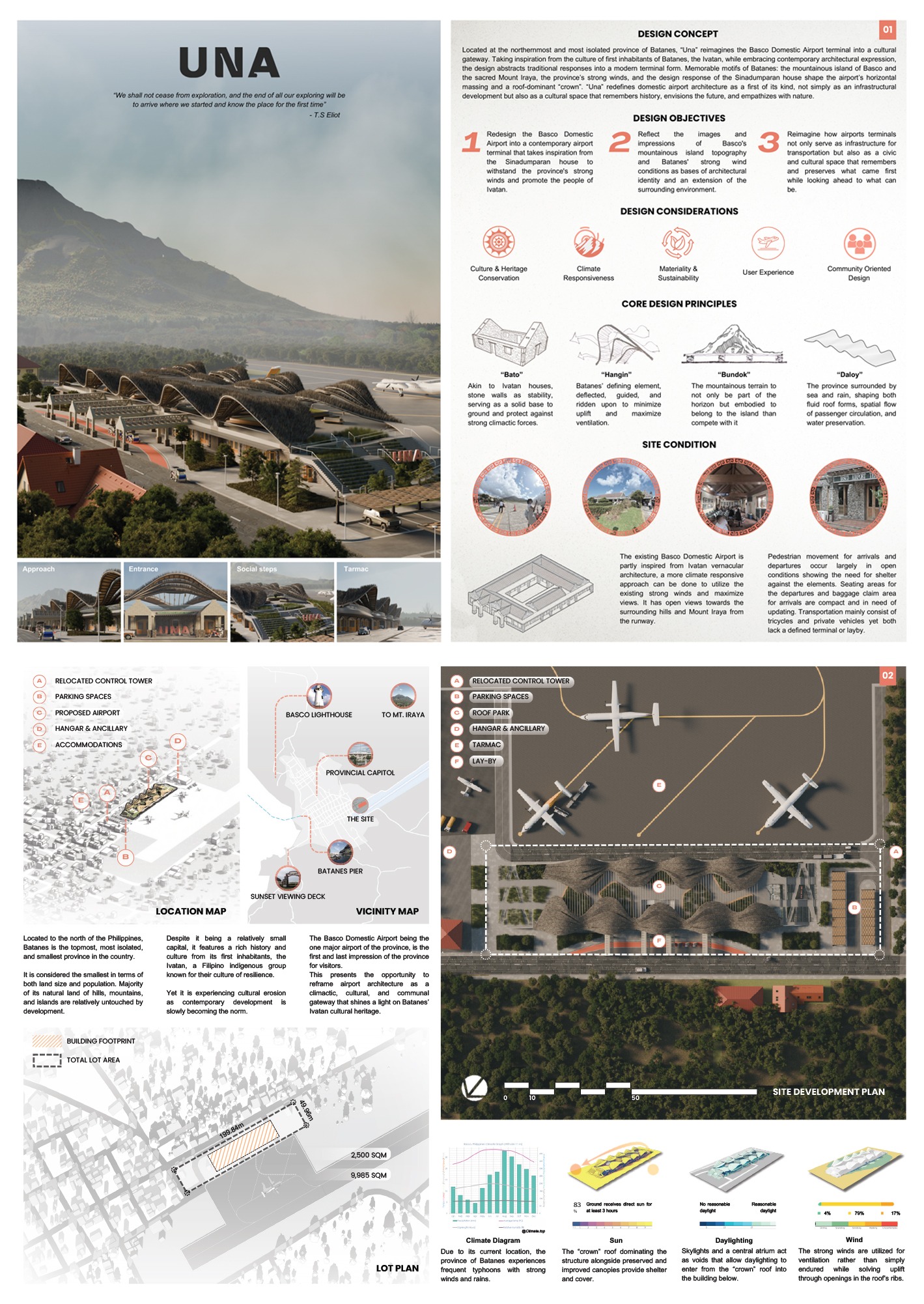
Located at the topmost part of the Philippines, Batanes is the most isolated and smallest province in the country. Its capital municipality, Basco, holds the one major gateway to the province, the Basco Domestic Airport Terminal. A benefit from this isolation is the preservation of its natural landscape of rolling hills, cliffs, and mountains, which provide breathtaking views for its residents and tourists.
The first inhabitants of the islands of Batanes, the Ivatan are an indigenous Filipino group that has learned to live in the harsh environment of the northern province. Iconic to their culture of resilience is the Sinadumpara, a house designed and built to withstand extreme weather conditions of strong winds and rain through a “Crown” roof. Locally available materials such as limestone and thatched grass and leaves are used as construction materials and as protective clothing, Vakul, against the sun and rain. Despite this rich heritage of Batanes’ indigenous people, it experiences cultural erosion as contemporary development is slowly becoming the norm.
“Una” connects both modernity and tradition instead of drawing a divide between them, seeking to strike a balance between cultural roots and forward-looking design. “Una” is driven by the heritage and culture of the Ivatan, the mountainous landscape of Basco, and the presence of strong winds. Through the method of architectural abstraction, these memorable motifs of Batanes become the bases to translate memory and environment into form.
The Sinadumparan’s architectural solutions to the extreme weather are expressed through horizontal massing and roof-dominant expression. The sacred Mount Iraya dominates the mountainous island of Basco, which can be seen in the background of the existing airport. This is abstracted making the airport an extension of the terrain rather than a standalone object. In addition are accents of rhythmic ribs and openings shaped by the province’s strong winds, expressing the transition from land to air.
To ground the airport in reality, locally available materials are mainly used alongside preserving aspects of the existing airport. Alongside is the addition of a civic park beneath the crown serving as a public space for the community and a waiting space with an open view of the surroundings for travelers. “Una” merges ideas from the Ivatan vernacular, contemporary culture, and the environment to redefine airport architecture as a first of its kind, not simply as infrastructure but also as a cultural space that remembers history, envisions the future, and empathizes with nature.